
INSIDE CONNECT LABS - STORIES FROM OUR MEMBERS
Same Floor, Different Science, One Patient
Article Provided by Connect Labs Charlotte Member, Advisory 5.
Written by Igor Gorlatov, Advisory 5: June 2026
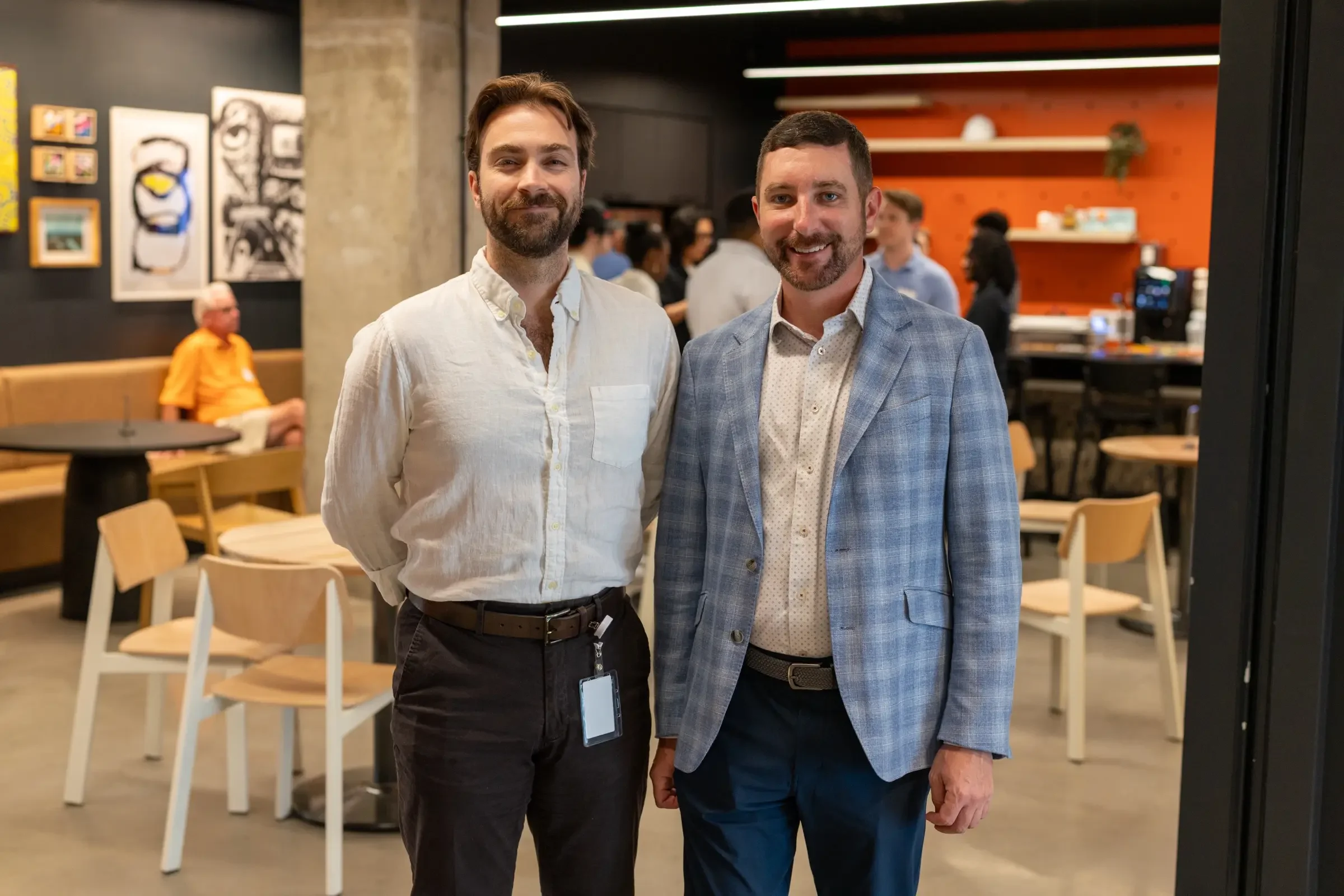
Cody McHale and Steve St. Onge at Connect Labs Neighbor Night
How Two Biotech Companies at the Pearl Are Finding Each Other
Cody McHale needed to talk to someone about pulmonary drug development regulatory pathways. He did not schedule a call. He did not send an email. He walked down the hall on the seventh floor of The Pearl Innovation District and found the person forty feet away.
That person was Steve St. Onge, Chief Business Officer at Clarametyx Biosciences, a clinical-stage company developing therapies for chronic respiratory diseases. McHale serves as Chief Operating Officer for Tract Bio, a biotechnology company focused on cancer and inflammatory diseases. Until recently, treatment for cystic fibrosis, a devastating lung disease, was not a major focus for Tract Bio. The hallway changed that.
Two Technologies, One Patient Population
Tract Bio’s novel and proprietary stemECHO platform isolates and clones patient-specific epithelial stem cells at scale while preserving their genetic and epigenetic identity. This includes cloning the pathogenic stem cells in chronic inflammatory disease, such as those in cystic fibrosis that appear to underlie the disease’s stubborn resistance to CFTR modulator therapies. This work, published in the American Journal of Respiratory and Critical Care Medicine (2023), highlights the novelty and power of cloning pathogenic stem cells to understand — and ultimately overcome — treatment resistance in chronic lung disease.
McHale was recruited from Atrium Health’s Levine Cancer Institute to join Tract Bio at The Pearl.
“Our core competency is epithelial stem cell biology. We can do what no one else can. What comes out of the patient is exactly what we grow in the incubator. It’s truly the engine for personalized medicine.”
— Cody McHale, Chief Operating Officer, Tract Bio
Clarametyx Biosciences, based in Columbus, Ohio, is addressing chronic respiratory disease with its own novel therapy. The company’s lead candidate, CMTX-101, is an immune-enabling monoclonal antibody that collapses bacterial biofilms, the protective shields that make infections resistant to antibiotics and immune response. In January 2026, Clarametyx reported positive Phase 2a data in cystic fibrosis and is actively planning its next study in bronchiectasis and cystic fibrosis. The company has raised $44 million in private capital and is currently raising Series B funding to support further development of its lead asset.
One company is going after the stem cells that cause and sustain chronic lung disease. The other dismantles the proinflammatory bacterial structure that drives progressive lung function decline. Both have cystic fibrosis patients in their sights. Both work on the same floor at The Pearl.
The Walk Down the Hall
Tract Bio has long been interested in using lung stem cells to repair damaged lungs and in creating new medicines for serious lung problems. Building on this work, the company recently saw a promising chance to develop a first-of-its-kind therapeutic for acute lung injury. McHale’s instinct was to walk to Clarametyx’s space to discuss consultants, regulatory pathways, and key opinion leaders.
“I can walk down the hall and talk to someone instead of making a phone call or shooting an email. That speaks to the collaborative ecosystem.”
— Cody McHale
Importantly, the conversation also opened the door to working together against respiratory disease from different angles — decreasing the chronic inflammation that led to lung damage and wiping out the stubborn stem cells that keep the disease going.
“There’s a version of biotech where every conversation requires a calendar invite three weeks out. That’s not the ideal pace to work at when patients are desperately waiting for our innovation to reach the market. At The Pearl, biotech companies can hash out critical answers about drug development over lunch or coffee. We’re redefining what’s possible in an emerging biotech city like Charlotte. When I look at where the next decade of pulmonary medicine is going, a cure is not going to come from any single platform or any single mechanism. It’s going to come from combinations of approaches innovators are trying to move forward. Sitting down the hall from a company like Tract Bio is the kind of collaboration that generates a life-changing medicine for patients.”
— Steve St. Onge, Chief Business Officer, Clarametyx Biosciences
Why Charlotte
Tract Bio chose Charlotte over Research Triangle Park and Boston. The company’s two Chief Scientific Officers are full professors in Cancer Biology at Wake Forest University School of Medicine and members of the NCI-designated Atrium Health Wake Forest Baptist Comprehensive Cancer Center. Tract Bio holds a sponsored research agreement with Advocate Health, connecting it to clinician scientists across the system who provide patient tissue and translational expertise.
“We chose Charlotte because of the strength of the new academic healthcare system, as it relates to Wake Forest and Advocate, and Charlotte’s status as a financial services hub. We didn’t want to put down roots in Boston or RTP. This was a very unique opportunity.”
— Cody McHale
McHale spent years inside the Atrium Health system before joining Tract Bio. He sees the convergence as unprecedented.
“The academic healthcare system here has provided fruitful soil to grow entrepreneurship, which has never existed in Charlotte before on a biotech level. I’ve lived in Charlotte since 2018. I’ve been in the Carolinas for over a decade and a half. I never thought a company and a job like this would be available in Charlotte.”
— Cody McHale
What This Signals
The Pearl Innovation District opened its first phase in June 2025 as a $1.5 billion investment in health, research, and education. The early evidence suggests the investment thesis is working: put research, clinical translation, and entrepreneurship in physical proximity, and the connections form on their own.
A cancer biology company exploring pulmonary applications. A clinical-stage respiratory company with positive data in cystic fibrosis and plans to target diseases such as COPD and beyond. A hallway between them. What happens next is their story to write. But the conditions for it exist because Charlotte built them.